Motherboard
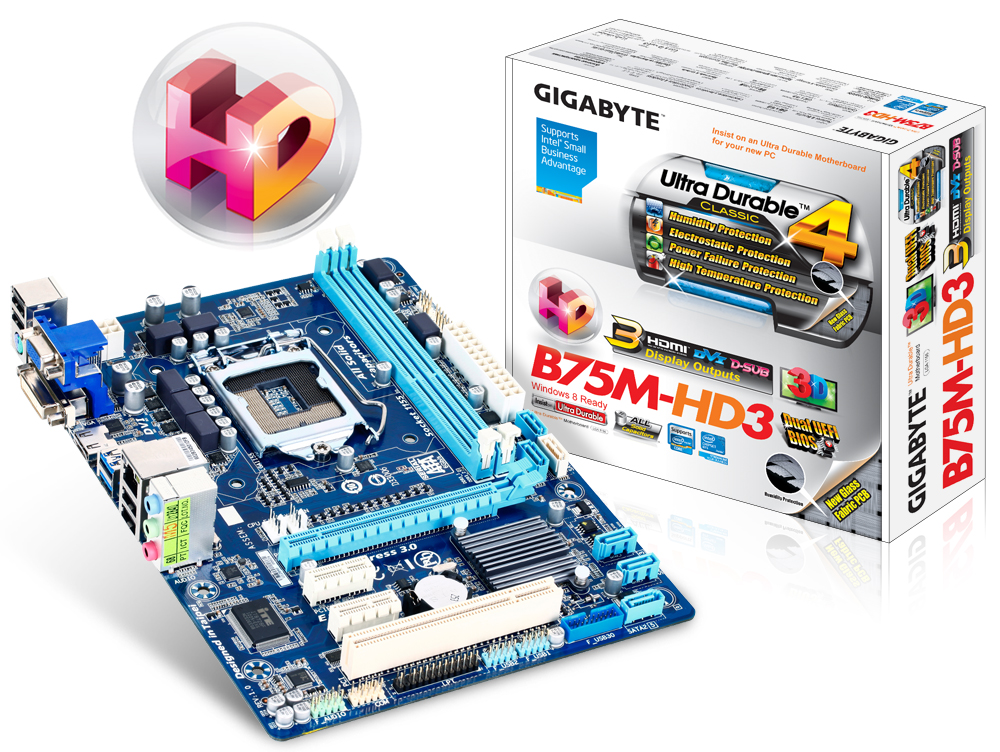
Gigabyte B75M-HD3
Motherboard specifically refers to a PCB with expansion capability
- the board is the "mother" of all components attached to it, which
often includesound cards, video cards, network cards, hard drives or other forms of persistent storage, TV tuner cards, cards providing extra USB or Firewire slots, and a variety of other custom components. (The
term mainboard is applied to devices with a single board and no additional
expansions or capability - in modern terms this would include controlling
boards in televisions, washing machines and other embedded systems, which are not true
motherboards.)
Prior to the advent of the microprocessor, a computer was usually built in a
card-cage case or mainframe with components connected by a backplaneconsisting
of a set of slots themselves connected with wires; in very old designs the
wires were discrete connections between card connector pins, but printed
circuit boards soon became the standard practice. The Central Processing Unit,
memory and peripherals were
housed on individual printed circuit boards which plugged into the backplate.
During the late 1980s and 1990s, it became economical to move an
increasing number of peripheral functions onto the motherboard. In the late
1980s, motherboards began to include single ICs (called Super I/O chips)
capable of supporting a set of low-speed peripherals: keyboard, mouse, floppy disk drive, serial ports, and parallel ports. By the late 1990s, many personal
computer motherboards supported a full range of audio, video, storage, and
networking functions without the need for any expansion cards at
all; higher-end systems for3D gaming and computer graphics typically
retained only the graphics card as a separate component.
The most popular computers such as the Apple II and IBM PC had published schematic diagrams and
other documentation which permitted rapid reverse-engineering and third-party replacement
motherboards. Usually intended for building new computers compatible with the
exemplars, many motherboards offered additional performance or other features
and were used to upgrade the manufacturer's original equipment.
In this
time, need to talk about desire item.
Today I’m
going to write about motherboard [GA-B75M-HD3]; who supports Intel Processor (Celeron to Intel Core i7).
The new
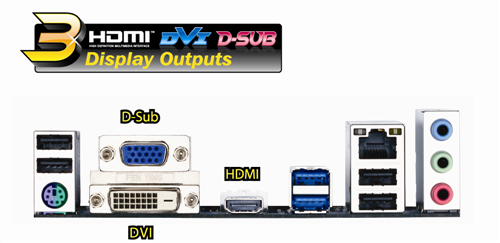
GIGABYTE HD motherboard series defies the current ethos that means true digital
display outputs are reserved for upper mainstream models, adding both HDMI and
DVI ports to a range of motherboard models at attractive and affordable price
points. All DIY enthusiasts can now enjoy true HD display capability using the
most commonly integrated digital output technologies on today's HD displays and
TVs.
Intel® Small Business Advantage
Ø SOFTWARE MONITOR
Ø DATA BACKUP & RESTORE
Ø USB BLOCKER
Ø PC HEALTH CENTER
Ø ENERGY SAVER
Ø Intel® WIRELESS DISPLAY
GIGABYTE Ultra Durable™ 4 Classic
motherboards embrace a range of exclusive features that guarantee DIY PC
builders the absolute best protection for their PC, with built-in features that
prevent common malfunction threats users encounter on a day-to-day basis.
Ø Humidity
Protection
Ø Electrostatic
Protection
Ø Power
Failure Protection
Ø High
Temperature Protection
Designed for PCI Express Gen.3 Support
GIGABYTE 7 series motherboards take advantage
of the latest connectivity and expansion bus technologies available on the
Intel platform. The 3rd generation Intel® Core™
processor platform debuts the new PCI Express gen. 3.0 expansion bus, allowing
users to take advantage of the next generation, high-bandwidth discrete
graphics card solutions.
* PCIE Gen.3 is dependent on CPU and expansion card
compatibility.
Intel® Rapid Start Technology
Intel® Rapid
Start Technology™ gets your device up and running faster from even the deepest
sleep. This means users will be able to experience almost zero power draw from
their PC, but be able to resume Windows® 7 is a
few seconds without having the PC go through a full system boot. With Intel® Rapid
Start Technology the previous session resumes to the exact as it was, so that
applications are still in the same state and no application data is lost.
Intel® Smart Connect Technology
Intel® Smart
Connect Technology means that your email, favorite apps, and social networks
are continually and automatically updated even when the system is asleep. No more waiting for the latest world
news or friends' updates to be delivered—just press the 'on' button and you're
up-to-date and ready to go.
Intel® Quick Sync 2.0
Saves your valuable time when create and edit
video, synchronize it with other devices, and share it–at home and on the
internet. Intel Quick Sync Video uses hardware on the processor, instead of
software, to accelerate video encoding.
DirectX 11 Support
Microsoft DirectX 11
provides eye-popping 3D visuals found for today's latest PC games and is
designed to be more efficient, leverage the power of today's multi-core processors,
and provide support for sophisticated shading and texturing techniques such as
tessellation.
UEFI DualBIOS™
Technology
With a superior graphical
interface capable of 32-bit color imaging and fluid user-friendly mouse
navigation, UEFI DualBIOS™ makes BIOS configuration a new and exciting
experience for novice and experienced users alike. UEFI BIOS also brings native
support for large hard drives on 64-bit operating systems.
50,000 Hours
Solid Capacitors
GIGABYTE Ultra Durable
motherboards are equipped with solid capacitors. With an average lifespan of
50,000 hours, these solid capacitors provide the stability, reliability and
longevity essential to meet the power needs of high-end processors and other
components running today's most demanding applications and games.
SuperSpeed USB
3.0
GIGABYTE motherboards
boast SuperSpeed USB 3.0 technology made possible through an additional onboard
host controller. With superfast transfer rates of up to 5 Gbps, users are able
to experience a theoretical 10x improvement over USB 2.0. Additionally,
backwards compatibility with USB 2.0 assures users of long term use of their
legacy USB 2.0 devices.
SATA 6 Gbps
GIGABYTE motherboards are
High-Speed SATA Revision 3.0 compatible, delivering superfast 6Gbps link speeds
for twice the data transfer rates of SATA Revision 2.0 (3 Gbps).
On/Off Charge
Technology
GIGABYTE On/Off Charge
technology allows you to charge your iPhone, iPad and iPod Touch regardless of
whether your PC is on, in standby mode or even off. A derivative of GIGABYTE's
highly acclaimed 3x USB Power feature, On/Off Charge enables devices to draw
more current from GIGABYTE motherboard USB ports than standard USB ports allow,
so that charging from your PC can be as fast as with a charger.
HDMI™-The Next
Generation Multimedia Interface
HDMI™ is a High-Definition
Multimedia Interface which provides up to 5Gb/s video transmitting bandwidth
and 8-channel high quality audio all through a single cable. Able to transmit
superior, uncompressed digital video and audio, HDMI™ ensures the crispest
rendering of digital content up to 1080p without the quality losses associated
with analog interfaces and their digital-to-analog conversion. In addition,
HDMI™ is compatible with HDCP (High-bandwidth Digital Content Protection),
allowing the playback of Blu-ray/HD DVD and other protected media content.
DVI Support
DVI (Digital Visual
Interface) is a video interface standard designed for carrying uncompressed
digital video data and to maximize the visual quality of digital display devices, such
as LCD monitors, digital projectors, and so on. In addition, the DVI interface
is compatible with HDCP (High-bandwidth Digital Content Protection).
Motherboard Overview
CPU Compability:
- Support for Intel Core i7 processors/Intel Core i5 processors/ Intel Core i3 processors/Intel Pentium processors/Intel Celeron processors in the LGA1155 package
- L3 cache varies with CPU
Memory Support
- 2 x 1.5V DDR3 DIMM sockets supporting up to 16 GB of system memory
- Dual channel memory architecture
- Support for DDR3 2200(OC)/1600/1333/1066 MHz memory modules
- * To support DDR3 1600 MHz, you must install an Intel 22nm (Ivy Bridge) CPU.
- Support for non-ECC memory modules
- Support for Extreme Memory Profile (XMP) memory modules
- * To support XMP memory, you must install an Intel 22nm (Ivy Bridge) CPU.
Onboard Graphics
- 1 x D-Sub port
- 1 x DVI-D port, supporting a maximum resolution of 1920x1200
* The DVI-D port does not support D-Sub connection by adapter.
- 1 x HDMI port, supporting a maximum resolution of 1920x1200
Sound System
- Realtek ALC887 codec
- High Definition Audio
- 2/4/5.1/7.1-channel
Image Gallery
Click here for further info